
They were three days north of Helix, up where the land begins to climb toward the mountains, when the stranger walked into the firelight, and Bancroft’s first clear thought was that the mace had been right about the north again, and his second was that being right and being safe are two different animals.
Irulan was not with them. She had gone back down to Helix for rations, being the only one who could carry a load and the only one with coin to buy it, and she had not made it back. So it was the three of them at the fire – Bancroft in his chain and his green cloak with the shield near to hand, Anister the ranger keeping the edge of the dark, and Clarisse the thief, who trusts nothing in this forest and has been proven right more often than any of them like. They were setting the camp for the night, half expecting spiders the way you expect rain in a wet season, when the branches moved. What stepped out was no spider but a half-orc – shaven-headed, dressed in a shag of wolf and spider fur, a pair of little spectacles perched on his nose – his hands open like a man who has decided the worst thing in these trees is not himself.
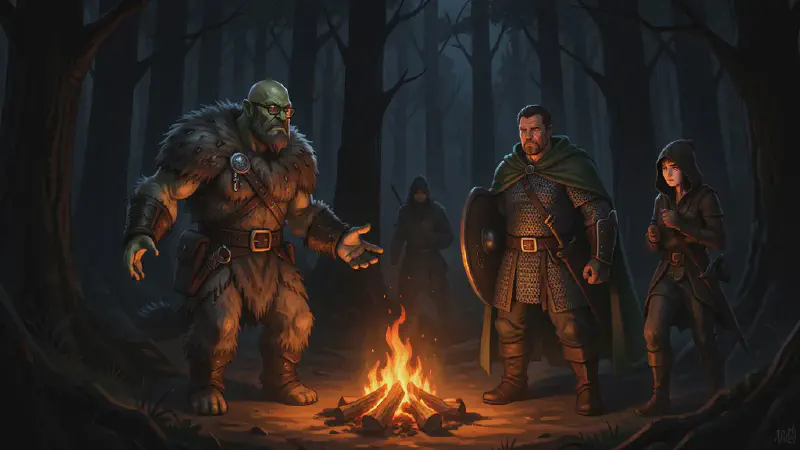
The stranger had only come, he said, to see who was fool enough to be camped this deep in the Black Forest. It was Bancroft who did the explaining. They followed the green god, he said, and were looking for a man up here who did the same – someone worthy, the mace had promised, waiting somewhere to the north. He kept the mace itself out of it; a stranger does not need to know you carry a holy weapon that keeps a list of men to kill. But he had said enough. The half-orc’s brows went up over his little spectacles. A priest of the green god, he said. Out here. Well. He gave his name as Shacknub – a shaman for his tribe once, before he took up the wizard’s road, and his master had granted him one spell more than a man of his standing had any right to. He counted them off proud as a boy with a new knife: mage armor, burning hands, a sleep. No light. Bancroft noticed the no light and filed it away.1
Anister would not be easy about him for a moment. It was a con, he was sure of it, a trick of Jeff’s – he means the world itself when he says Jeff, the way a man out here comes to feel there is a hand arranging the bad luck – an extra body pushed on them because they were down to three and three is not enough in this country. He turned it over and over. He wanted to roll dice at the man to learn what he was. You cannot do that, Bancroft could have told him. You either believe a man or you don’t, and if you get a whiff of him you get a whiff of him, and no die ever spat out the truth of a soul. In the end they fed the stranger. Anister had fresh rations enough for the party and grudged the extra one, and Clarisse gave up a slot of her own so the newcomer could eat, and that was the whole argument settled the way most of Bancroft’s arguments settle – somebody hungry going a little hungrier so a stranger doesn’t.
That was the first night. Clarisse heard something in the trees and woke Anister with the fear on her, and Anister went blind into the dark after it and found nothing – he is the best set of eyes they have and even he came up empty, twice.2 They put a light on a stone and threw it out south where the sound had come from; it landed in the wet leaves, lit thirty feet of empty forest, and told them nothing. There is a particular tiredness that comes of standing watch against a thing that will not show itself. Bancroft knows it well by now.
It was on that watch that he had it out with the mace again.
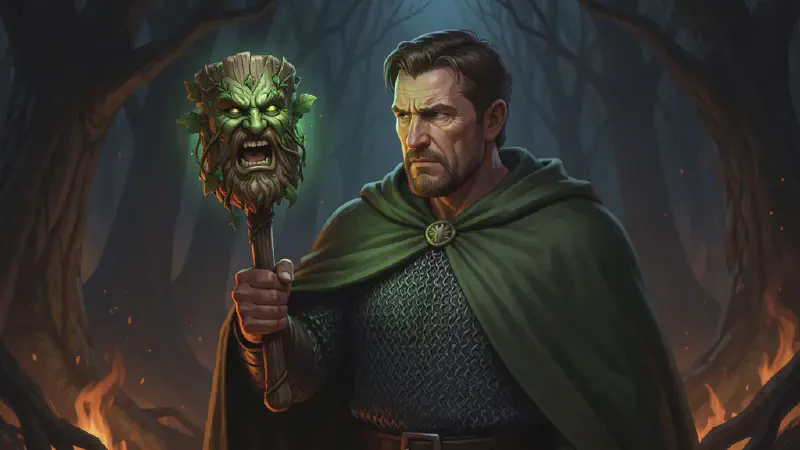
He reached into his pack and took the Green Man out and asked it, plain, whether the noise in the woods was another friend of the god’s, sent to guide them. The mace did not care about the noise. It never cares about anything but the one thing. It wanted to know the names of paladins. It had him recite, off the memory of nights spent sleeping rough in the Saint Yigin soup kitchen, the names of two of them – Arthur Schuster, who feeds the poor and preaches at them while he does it; Mortimer Saltmarsh, who heals the sick – and Bancroft heard, in the dark behind his own eyes, the dry scratch of the dead priest writing them down. Next time you see Arthur Schuster, kill him, it said, mild as a man ordering supper. It has a list. It called it a kill desk. It wants the temple of Saint Yigin burned to the ground and the ashes spread on a field to grow a good crop, best use of a body it can think of. And it told Bancroft again, the way it tells him most nights, that he was not worthy of it – that its last owner would have hired a retinue of the god’s own scouts to sweep this forest clean, and that Bancroft, who cannot even keep them all fed, ought to hand it to some richer man who could put it to proper use. If you are not going to wield me, it said, give me to someone who will. Bancroft looked at the carved green face a while and put it back in the pack. A man does not argue theology with a stick. But he thinks about it. He thinks about it a good deal.
Morning came wrong. The first thing was the smell – sulfur, thick and low – and then the sky began to rain ash and ember down through the black canopy, little motes of fire settling on their arms and in their hair, the clouds overhead roiling hot and yellow. Shacknub had a name for it, said proper as a scholar: Hellmouth clouds. He said find shelter, quick, and there was no arguing the sky. They coughed and smarted and burned a little all the way to a small hill with a cave in it. The cave was choked with old web to the roof, a spider’s larder gone empty, but it was stone over their heads and out of the fire, and they pushed through the sticky dark and waited the burning out. It died down by noon. That is the country the mace has led them into. A place where the very weather wants to cook you.3
The cave’s proper tenants came back for it that night. Giant spiders, three of them, at the mouth of the cave, close enough to touch before Bancroft on watch even heard them – and yet they did not rush in. They sat at the entry and watched. Bancroft caught up a torch, waved it, and asked them, out loud, foolish as it sounds, to go in peace, all of them creatures of the green god together; and whether it was the fire or the god or plain spider sense, they held off. He reached for the god’s protection over himself and the prayer went nowhere, dropped like a stone down a dry well, and he marked it used and got nothing for it. It was Anister who moved them. He has a way with wild things that is worth more than any spell Bancroft owns – put a wanting into a beast’s head, make leaving seem its own idea – and he did it now, clean, and the three of them backed slow out of the firelight and melted off into the trees. They ringed the cave mouth with little fires and got through to morning.4
That is the shape of the whole road north, Bancroft has come to see. The mace will not tell them where they are going, only that they are going. There were no ley lines over the cave – Shacknub can see the things, squinted up and said so – so the mace sent them casting east until they found one, and the one they found the wizard named the Line of Woe, and said a man walking it feels watched by something that means him no good. Follow it, the mace said, pleased. Go east, young man. And they went, because north and now east are the only words it knows, and because Bancroft has staked his god and his good name on the thing having a reason.
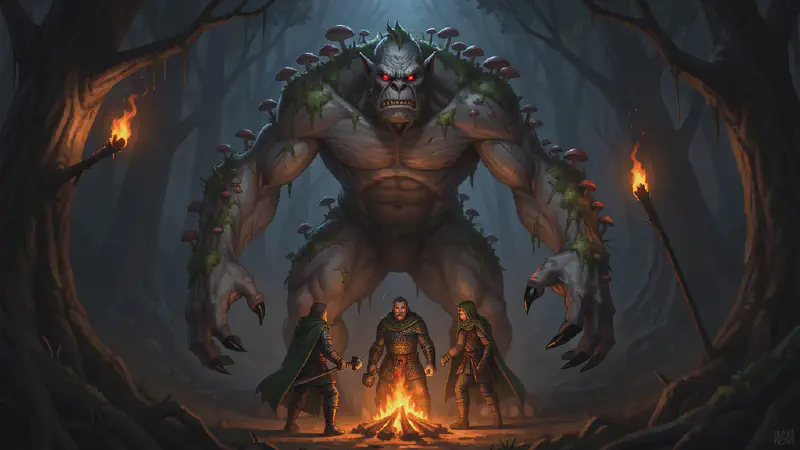
The guides got stranger from there. One night a thing stood up out of the dark that Bancroft had taken for a low hill – fifteen feet of it, lean grey skin with moss and mushrooms grown into its hide, red eyes catching the torchlight, licking its chops at them from sixty feet off. A troll. Anister knew it for one and said the word quietly, which is not a word you want to hear quietly. And it did not come on. It bellowed something none of them could make out, and Bancroft stood his ground by the fire with his hand on the mace and did not draw it, and tried, God help him, to meet the thing eye to eye like a fellow creature – for it lived in the green god’s forest, and the mace had promised him worthy men waiting up ahead, and a man who has decided to read the whole world as a message from his god will read a troll that way too if he has to. It was Anister in the end who talked to it, after a fashion, with his hands and his voice, and got worse than nowhere and then somewhere – the troll pointed them southeast, plain as a signpost, then turned and crashed off into the wood, and only then did they see it had not been alone. Several sets of red eyes shambling away southwest into the black. Anister said afterward it was like telling a man his boat is full of eels. But they took the direction. They always take the direction.5
Bancroft had begun, by then, to believe. That is the thing he will have to answer for later. The stranger who found them, the troll that pointed the way, the spiders that watched but would not bite – he had stitched them all into one story, a man being walked by the hand of the green god toward some holy place where the mace would find its worthy priest and the church of the Green Way would rise up green out of the salted ground. Anister the ranger kept telling him the animals were behaving wrong, that spiders do not herd and trolls do not give directions, that something was making the woods act against its own nature. Bancroft heard him and thanked him and went on believing anyway. It is a hard thing to say now which of them read it truer.
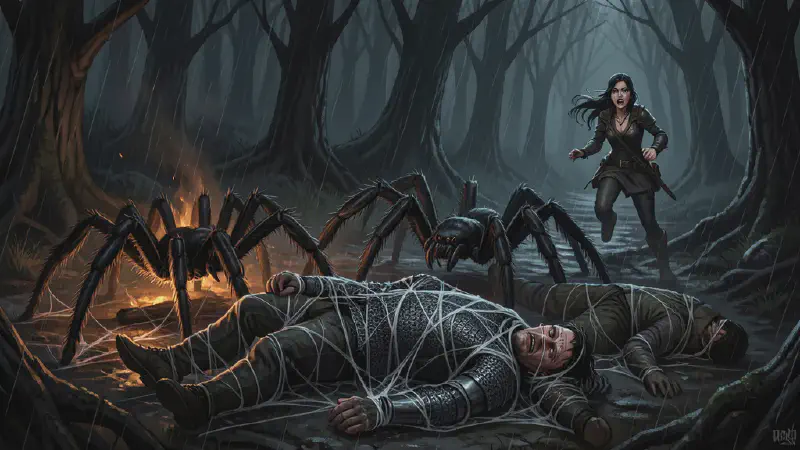
They found out on the last night, in the far corner of the forest the mace had walked them into, in the worst dark of the month, a week gone past the silver moon. Bancroft was on watch and the spiders came streaming into the camp before he could get a hand up – more of them this time, six, and no waving them off. One bit him where he stood and the poison took him in a breath, and he went down stiff as a fence post, awake, aware, unable to move a finger, and lay there in his own camp watching them come for the others. He had not even his armor on. Anister took the poison too and locked up beside him. Shacknub, torn from sleep, was bitten and bitten again. And the spiders did not kill them. That was the horror of it. They wrapped them – Bancroft felt the web go round him, round and round, felt himself lifted, felt the world go dark and close and silk-bound while his mind stayed wide awake inside it – and began to drag the three of them off into the trees to be kept, like meat put up in a smokehouse for a later day.6
Only Clarisse got clear. She was the one the poison missed, and she did the sensible thing, the thing Bancroft could not have done in her place: she did not die trying to save three grown men wound up in silk. She threw oil and tried to raise a fire, and it would not catch, so she ran – broke off into the dark and hid, hid again when they hunted her, lost them somewhere in the black forest, and spent the rest of the night up a tree, rocking, waiting on a word from Anister that was not coming, while every friend she had went quiet in the web behind her.
And Bancroft, wrapped and blind and hauled off through a forest he cannot see, on a road his god will not explain, with a murderer’s relic in his pack telling him he was never worthy of it – Bancroft, so far as any of them know, still has his faith. He would tell you these are only the strange ways of it. He would tell you there is no problem here. A man raised on a farm learns to trust that the seed put in the dark ground comes up in the spring, and does not ask the dirt to prove it first. We will find out, come next week, whether the green god is as good as His word.
The half-orc Shacknub arrives at the camp – a former tribal shaman turned wizard, carrying mage armor, burning hands, and sleep (but no light spell). Bancroft explains the party’s quest, and the stranger pegs him for a priest of the green god. The DM rolls to gauge whether the party can read him; the result is inconclusive, leaving him neither trusted nor exposed. The party spends a ration to feed him, Clarisse freeing an inventory slot to cover it. ↩︎
On first watch Clarisse hears movement and wakes Anister. His Wisdom (perception) check comes up a natural 1, and a second search turns up nothing. A Light spell cast on a thrown stone illuminates roughly thirty feet of empty forest to the south; perception checks (14, 3, and Clarisse’s 13) reveal no source for the noise. ↩︎
The DM’s name for the sulfur-and-ember fall is “Hellmouth clouds” – it costs the whole party 1 point of damage from smoke and settling embers before they reach cover, and they shelter in a web-choked cave until it burns itself out around midday. A party that keeps getting mauled in the same stretch of cursed wood is, in the Sunnydale sense, plainly living on the Hellmouth – they’ve only swapped the high-school library for a spider’s cave to regroup in. ↩︎
Three giant spiders return to reclaim the cave. Bancroft waves a lit torch and pleads with them (Charisma 9 – enough to hold them off, not to learn more) and then casts Shield of Faith on himself, which fails. Anister drives the spiders off with his wild-animal skill on an 18, changing their behavior so leaving seems their own choice. The party rings the cave mouth with small fires for the night. ↩︎
A fifteen-foot troll appears at sixty feet. Anister identifies it on an Intelligence check of 15 (rolled with advantage). It proves non-hostile; after a round of gestured “conversation” it points the party southeast and departs – revealing several more trolls shambling off into the dark. Anister, who speaks Primordial and Sylvan, notes the troll’s tongue was neither. ↩︎
On the final night’s watch Bancroft is surprised by six giant spiders and rolls disastrously; bitten, he fails his save and is paralyzed, out of armor. Anister is likewise paralyzed and Shacknub bitten for 4. The spiders web the three men to haul them off rather than kill them. Clarisse – the only one unparalyzed – fails to start a fire with a thrown oil flask, then escapes on repeated Stealth checks (with a rogue’s advantage) and evades pursuit into the forest. The session ends on the cliffhanger of the three men bound and being dragged into the dark. ↩︎